🔥 INTRODUCTION
I still remember the first night I played Gears of War 2. Playing it in co-op with my brother (the Xbox 360 humming beneath us) this game absolutely detonated a bomb in my brain. We stayed up way too late, both of us wired, waiting to see what insane thing it would throw at us next. Every set piece, every unhinged ‘holy shit’ moment carved itself into my memory.
Years later, I kept hearing people say, “Yeah, I love 1 and 3… 2 is the weak one.” And I’d just sit there thinking: What game were you playing? Returning to it this year through backwards compatibility (upscaled, sharpened, rendered in 4K) I finally have the language to express what I felt back then. If Gears 1 laid the foundation and Gears 3 delivered the finale, then Gears of War 2 is the soul of the trilogy.
This isn’t nostalgia. This is a full breakdown: visuals, sound, gameplay, story, and the psychology beneath it, from someone who grew up with this series and still feels its impact today. If Gears of War: Reloaded was about revisiting the origin and testing whether it still holds up, then Gears of War 2 is about understanding why this world got under my skin in the first place.
🌄 VISUALS & WORLD DESIGN
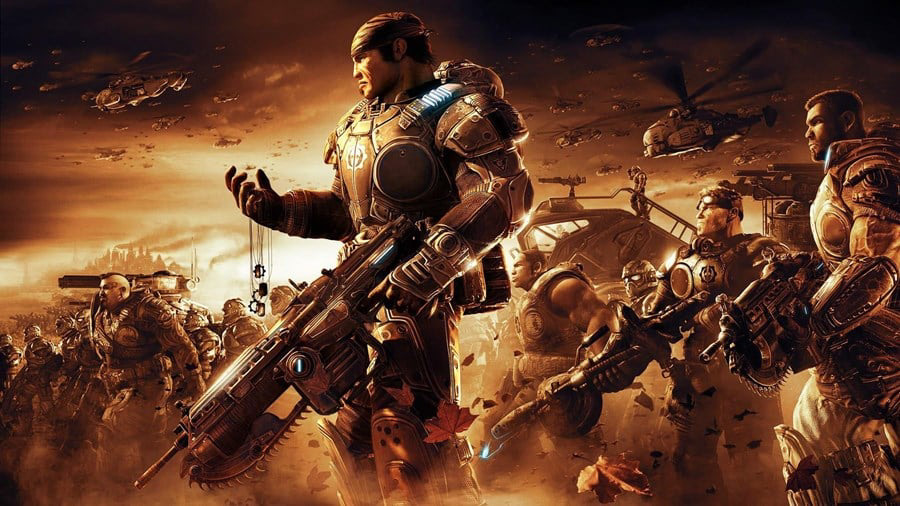
Released in 2008 and now replayed through backwards compatibility, Gears 2 lives in this strange space: technically dated, emotionally timeless. Thanks to the resolution bump, everything looks sharp and clean, but the underlying assets still belong to that era: stiff animations, chunky geometry, textures never meant to be seen this clearly. And yet, within minutes, I stopped caring.
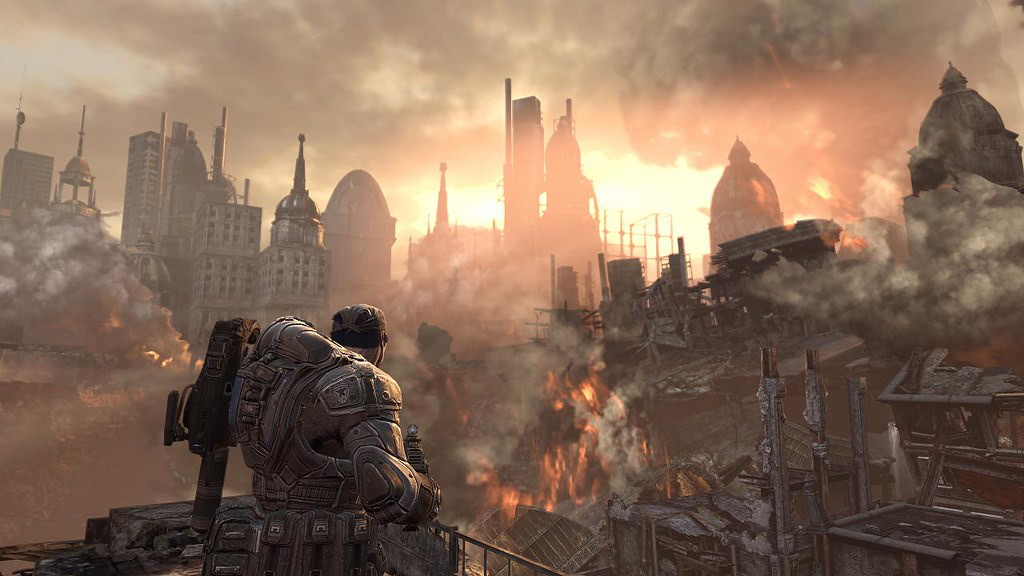
The magic isn’t in raw fidelity; it’s in how the world is staged. Jacinto, humanity’s “last safe city,” looks and feels exhausted. Soldiers limp through overcrowded infirmaries. Hallways are lined with improvised medical setups. Faces are caked in dirt, stubble, and fatigue. Dom looks like he hasn’t seen a shower or a good night’s sleep in months. The environment isn’t just torn apart by the war; it feels like a civilization clinging by its fingernails.
From there, the game escalates in a way that’s almost mythic:
The frontlines: The early acts sell the scale of the war: endless convoys, massive armored vehicles rolling across ruined landscapes, forests ripped apart by gunfire and artillery. You’re not saving a town. You’re trying to stop a planet from bleeding out.
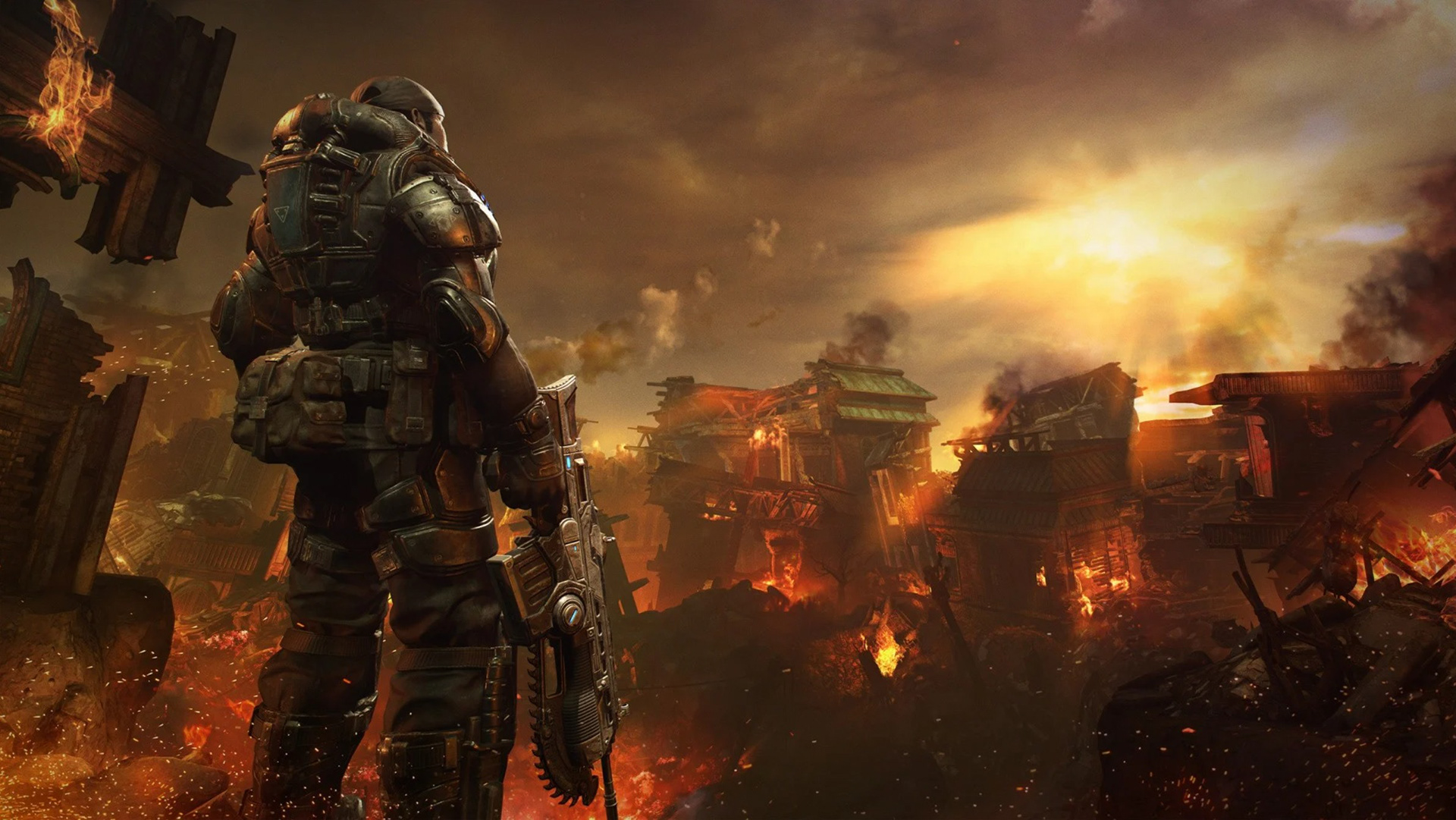
Jacinto under siege: Buildings crumble, streets fracture, whole structures collapse into the abyss as you fight. The city doesn’t just sit in the background; it’s actively being erased while you’re still in it. You feel like you’re running around inside a sinking ship.
The Riftworm: This is the descent into the planetary subconscious. You’re literally inside the thing that’s been swallowing cities, chainsawing arteries while gallons of blood pour over you. It’s grotesque, insane, and completely unforgettable. As a visual metaphor, it’s perfect: humanity is so desperate it’s carving its way through the guts of the problem. No strategy, no diplomacy, just raw survival.
The final act: The sideways elevator shootout, the massive creature battles, the frantic escape on enemy mounts, and that last, apocalyptic push as Jacinto sinks… it’s all escalation. Chapter after chapter, the world keeps morphing and collapsing around you.
What stands out now is how committed the game is to its vision. Gears 2 is not subtle. It gives you collapsing cities, titanic monsters, rivers of blood, and a civilization literally choosing to drown itself just to buy a chance at survival. But that excess has purpose: it mirrors the emotional state of the characters. The outer world is falling apart at the same speed as their inner world. If Gears Reloaded is a tight, gritty war story, Gears 2 is the nightmare that comes after: louder, bigger, more surreal… and somehow more human.
🔊 SOUND DESIGN
Gears has always had a distinct sonic identity, and Gears 2 doubles down on it. The iconic menu tones, the low boom of the checkpoint, the hum of the Lancer charging up: it’s all instantly recognizable. The mix still hits:
Weapons feel powerful and distinct. The Lancer’s roar, the heaviness of the Gnasher, the punch of the Longshot, the scream of the flamethrower: every tool has its own voice in the chaos.
Explosions and ambience land in that perfect zone where the world feels loud, oppressive, and constantly on edge, but never muddy. Every detonation, collapsing structure, and creature scream reinforces the atmosphere.
The score leans fully into the “war film” aesthetic: big orchestral swells, heavy percussion, and a masculine, militaristic energy. It’s not a melody you hum later like a JRPG theme, but when it kicks in, it fits. Especially during the big pushes and the escalating chaos of the final act.
Voice acting is where the heart really lives. Marcus, Dom, Cole, Baird: they all sound tired, pissed off, but still pushing forward. Dom breaking over Maria, the cracks in his voice; Marcus’ controlled tone when he knows his friend is collapsing; Ty’s hollow silence. These performances carry weight even through the older mocap. You don’t need hyper-realistic facial capture to feel what they’re going through.
Compared to Gears Reloaded, you can tell how much cleaner and more focused sound design became over the years (the remaster sharpened voices and effects) but the DNA is already here. Gears 2 sounds like a war that’s been dragging on far too long and taking everything with it.
⚔️ GAMEPLAY
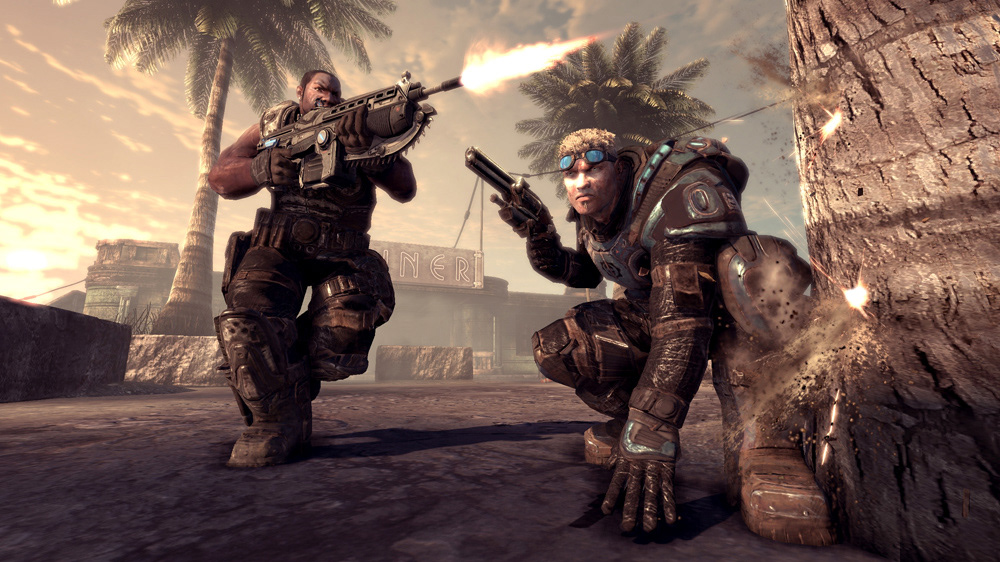
If Gears 1 is a heavy tank, Gears 2 is that same tank with the throttle wide open. Movement, vaulting, shooting: everything feels faster and more aggressive. You still have that classic Gears weight, but the pacing shifts toward something closer to a “Gears of War equivalent of MW2”: same core, more speed, more chaos.
You feel it in:
Combat flow: Encounters are bigger, messier, and more vertical. Enemies flank harder, more types stack together, and arenas feel designed to push you forward instead of letting you sit in cover forever.
Weapon sandbox: New tools like the flamethrower, burst pistols, and heavier weapons fit right in. Old favorites still dominate (Lancer, Gnasher, Longshot, Torque Bow), but now there’s more room to experiment. Taking hostages, stomping enemies, trading chainsaw duels: it all adds personality to the brutality.
Enemy variety: Shield carriers, flying threats, massive beasts, exploding critters, creatures bursting from pods, pilots riding mech-like monsters. Compared to Gears 1, the jump in diversity is huge. The world feels more alien and unstable because the game keeps throwing something new at you.
It’s not perfect, though. The aiming has this slightly “framey” snap to it that takes getting used to. Not unplayable, just not as smooth as modern analog tuning. Once you adapt, you can still enter that flow state: bouncing between cover, lining headshots, shredding everything like a one-man demolition squad. But it’s a learned rhythm.
And then there are the vehicle sections. The early tank mission is mostly fine: fun concept, slippery movement, the sense of crossing a fragile battlefield. The real problem is the short section on the frozen lake. Enemy projectiles smash the ice beneath you, and because the tank is so slick, you end up sliding into holes without much control. It’s a very small part of the game, but it definitely feels like a section that needed more tuning or playtesting. Thankfully, it’s over quickly.
On the flip side, the big machine sequences later absolutely land. Piloting massive rigs into battle, storming the frontline, hitching rides on Locust creatures to get back to Jacinto: those moments achieve what the snow tank section was aiming for: breaking up gunfights while feeding the cinematic fantasy.
And the final-act charge riding the Trumac into the towers to blow out the support columns is just brilliant. A perfect fusion of chaos, scale, and cinematic design, and one of the most memorable moments in the entire campaign.
Overall, the gameplay is exactly what Gears 2 sets out to deliver: A brutal, forward-driven, cinematic combat campaign that keeps escalating. It knows its identity and pushes it as far as it can go.
📖 STORY & CHARACTERS
At first glance, Gears of War 2 seems straightforward. Humanity is almost finished. The Locust are sinking cities. You have one last chance to strike back before everything is gone. Underneath that, it’s a story about what people cling to when everything else is stripped away.
Dom & Maria: Love at the edge of the world — Dom is the emotional core of this game. He isn’t fighting for abstract ideals or “the fate of humanity.” He’s fighting for Maria, for the hope that somewhere, somehow, she’s still alive. When he finally finds her, and we see what’s left… it hits. Even after all these years, that scene still stings. The image of him holding her, the way the game slows down to let the moment breathe: it isn’t shock value. It’s grief.
From a Jungian angle, Maria represents more than a missing wife. She is Dom’s inner center: his hope, his tenderness, his reason for enduring hell. When she’s taken from him in such a twisted way, he doesn’t just lose a partner; he loses the last clean image of what he’s fighting for.
And the fact that he continues the mission afterward is what gives him weight. His strength doesn’t come from being “tough.” It comes from being shattered and moving forward.
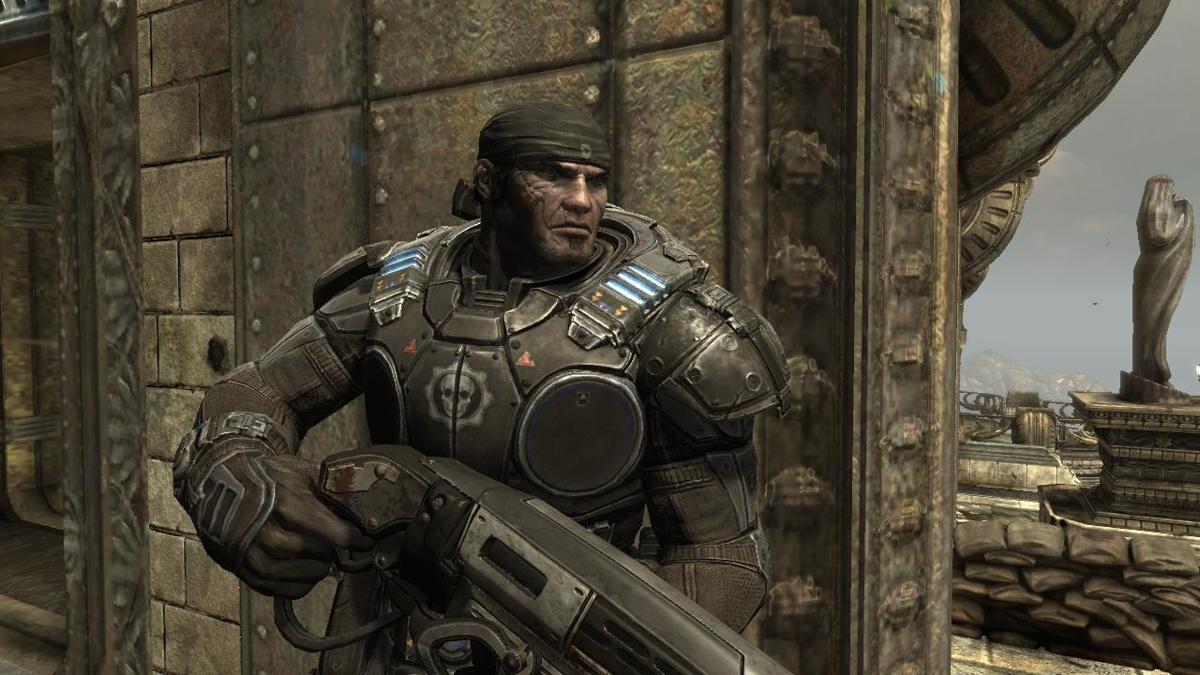
Marcus: The stoic will to carry the mission Marcus exists at the intersection of duty and buried emotion. He’s the kind of man who will always put the mission first, until that mission collides with the people he loves. There’s a crucial moment when Marcus decides to help Dom search for Maria. He knows the mission is critical. He knows time is short. But he also knows that without Dom’s heart, the mission doesn’t get done at all. That choice reveals who Marcus really is. He isn’t just a walking jawline in armor; he’s an honorable man whose loyalty is expressed through action, not speeches. Psychologically, he embodies the Warrior-King archetype: responsible for everyone, punished for every failure, and doomed to keep moving forward whether he wants to or not.
Ty: The myth of unbreakable strength Ty is introduced as this unshakable, legendary warrior: the man everyone respects. And then you see what the Locust did to him. By the time you reach him, he’s been tortured beyond recovery. When he’s handed a gun, he doesn’t fight. He checks out. It’s one of the darkest statements the game makes: even the strongest can break. Not in a cheap “war is hell” cliché way, but as a reminder that trauma doesn’t care about your reputation or legend. In Jungian terms, Ty is the Hero archetype collapsing under the weight of senseless brutality.
The Rookie: Innocence sacrificed The young soldier who jokes with you, fights beside you, and dies begging you to tell his loved ones he cared: that’s the game stripping away any illusion that this war is “epic” in a cool way. He’s not famous. He’s not special. He’s not destined for anything. He’s just a kid swallowed by a nightmare. His death hits because the game actually lets you warm up to him before it tears him away.
Cole, Baird, Anya, and everyone else — Cole remains pure chaotic life force: reckless, joyful aggression packaged in armor. His trash-talking-the-Queen scene is still hilarious, but it also matters: in a world this bleak, someone has to carry the flame of raw energy. Baird, with his sarcasm and intellect, is the rational, anxious side of the human psyche: the part that copes by thinking and complaining because feeling everything directly would be unbearable. Anya is quieter but crucial. The way Marcus speaks to her, the concern in his voice, the fear when he thinks she might be gone: it’s clear there’s something deeper between them, even if the game isn’t ready to explore it fully.
The Locust & Emulsion: A war within a war One of the most fascinating aspects of Gears 2’s story is how the Locust aren’t just monsters. They’re also desperate. Emulsion is corrupting their world. Their society is fracturing. The Queen isn’t invading humanity for fun; she’s trying to escape her own apocalypse.
This adds a twisted nuance: You’re fighting an enemy that is also fighting extinction. The war becomes a clash between two dying civilizations, both willing to do anything (even sink entire cities) just to survive one more day.
That’s where the writing shows its depth. The story doesn’t explain everything neatly, but the emotional logic is strong: This is a world where survival has crossed the line into self-destruction.
💭 PERSONAL TAKE
Playing Gears of War 2 in 2025 (after revisiting Gears Reloaded and with a whole lifetime of other games in between) I walked away thinking: “I don’t play many games this good anymore.” Not because modern games lack graphics or budget (they have plenty of that) but because so many of them feel like content, not statements.
Gears 2 feels like a team emptying the tank creatively and emotionally. You feel it in the credits when the devs dedicate their work to their families and loved ones. You feel it in how the campaign never coasts. It laughs, it screams, it bleeds, and it pushes you relentlessly toward the next moment.
This game made me: Laugh at Cole’s insanity and squad banter Get annoyed at that slippery snow-tank section Feel disturbed by Ty’s fate Go quiet after Maria Stand in awe at the destruction of Jacinto
It’s rare for a single campaign to cover that much emotional ground without losing its identity. Gears 2 never stops being Gears (loud, brutal, masculine, over-the-top) but within all of that, it finds moments of genuine tenderness, horror, and sacrifice. For me, this is where the series exposes its heart the most.
🧠 CLOSING THOUGHTS
Gears of War 2 is not just “the sequel.” It’s the moment the series stops being a cool tech demo and becomes a full myth.Visually, it’s a collapsing world delivered through bold, unforgettable set pieces. Sonically, it’s a war drum that never stops beating. Gameplay-wise, it’s faster, bloodier, more ambitious: sometimes janky, but never dull. Narratively, it’s about what you cling to when you’ve l
Dom fighting for Maria even after th
ost almost everything.
On a deeper level, it’s a story about humanity on its last nerve, and about individuals who keep going anyway. Not because they’re fearless, but because fear stopped mattering a long time ago.
e universe already took her. Marcus choosing loyalty over cold efficiency in a world that rarely rewards that choice. Humanity sinking its own city just to maybe earn one more sunrise.If Gears 1 is where the legend begins, and Gears 3 is where it concludes, then Gears of War 2 is the bleeding heart at the center: the part that reminds you why any of it matters.
For me, this is the soul of the series: Imperfect, ferocious, brutal, and full of love buried beneath layers of armor and ash.